
• BORED Logo

  • The Ultimate GPS Solution for Nikon?

10th March 2009

The Ultimate GPS Solution for Nikon?

By Tarkan | Permanent Link
Updated Mon, 16th March 2009
«»

Feature Set

When I had a dream about making a GPS device for my Nikon, I had this idea that if I can make it small enough maybe I can have the whole unit directly attached to the camera with no cables. I had several other criteria to meet, the unit was to be powered by the camera and also to be fully integral to how the camera behaves in terms of power control. I did not want a separate on/off switch and the GPS device had to enter and leave sleep mode as and when the camera did.Nikon GPS Early Prototype
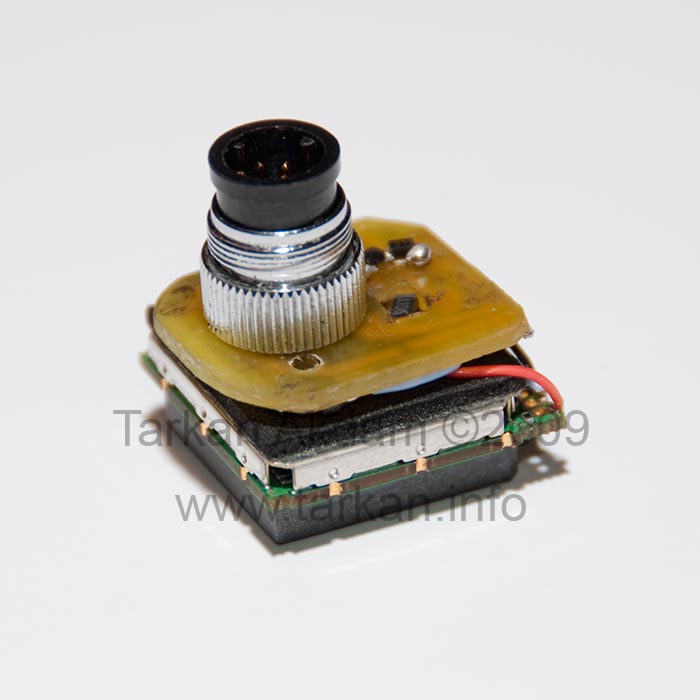
With my design I wanted to create something which is plug and play with a simple plug and forget attitude. I want it to work without having extra buttons, switches or usage constraints. I want to pickup the camera and take a picture knowing the GPS position has been recorded.

This also means this thing has to be tiny and when I mean tiny I mean tiny. As you will see my early prototype was so small it was directly mounted on the 10pin Nikon connector with no cable, but this was not viable as it meant difficulty pressing the Lense release and flash button.Nikon GPS Early Prototype on Camera
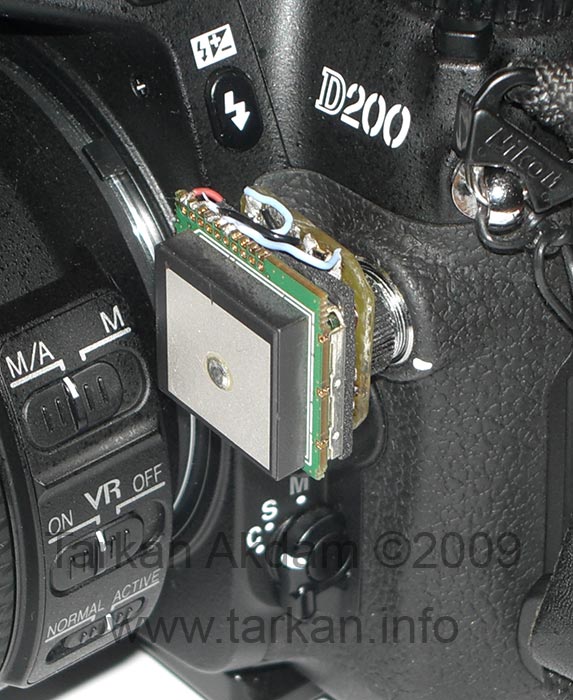
Performance this is important – I expect it to work inside buildings and other difficult locations, my little TomTom sat nav unit can – so should mine.

Finally, power or lack of. The unit will be running off the camera battery, so power requirements need to be small and some very aggressive power saving techniques need to be employed. As stated to be aware of the power savings of the camera.

Required feature set :-

  • Plug and play
  • Plug and forget
  • Miniature and discrete
  • Low Power
  • High Performance
  • Software driven intelligent device

First thing I obtained a Nikon 10-pin connector and slowly checked and measured each pin function, I created a chart showing the various states with the measured voltages. The states of interest are camera on , off , meter on, meter off (sleep mode) I checked the pins to see what was going on using the excellent chart hosted on Peter Miller’s website (link above).

Next major thing was to get a GPS module, I was on the look out for a tiny module which had excellent specs while still having plenty of power saving features – I knew of this Finnish company Fastrax, quick look over their website revealed the IT321 gps module measuring a eye-watering 14mm x 10.4mm x 2.3mm – Tiny. The great thing with this module was that it is based on the SIRFstar 3 gps chipset, so performance is guaranteed to be great!!

Finally I could look at the gps antenna – I personally believe the antenna makes or breaks gps units. Companies spend lots of money getting the antenna right and it is normally approached on a holistic basis – with the antenna designed once the rest of the device has been finalised. Most people tend to use patch antenna for gps devices, these are squarish ceramic based antenna. These work really well however they do have some drawbacks. First is detuning – when anything is placed near the antenna it detunes from its operating frequency, even plastic or human skin. Secondly, ground plane requirements – patch antenna to operate correctly need a large ground plane (large piece of copper), so for my project I calculated I would need a 20mmx20mm patch antenna to achieve the performance I was looking for the minimum ground plane would need to be at least 50mmx50mm – this is just too large for my needs.

So I started to look at helical antenna, they are much more compact and have much less detuning effect and the ground plane requirements are non-existent. I managed to track down an antenna made by Sarantel - it is small measuring just 13mm diameter x 15mm width and 49mm long with a waterproof rubber sleeve protecting the antenna element. The good stuff does not stop there – it also includes a low noise low current 24db gain amplifier. The other thing I have not mentioned pickup pattern – the direction the antenna is most efficient in. Well the helix has a 165degree cone shaped receiving pattern which is perfect for my needs.
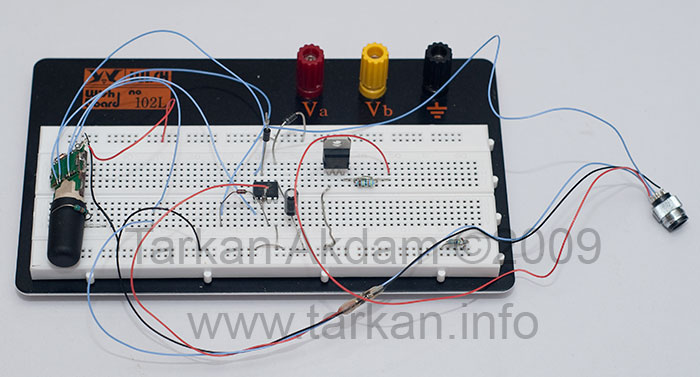
Nikon GPS veroboard

It was coming together well due to the size of antenna and gps module – I found that I could piggy back the gps module on to the antenna, so I now had to design my controller board to piggy back on to the antenna. This was going to be interesting as my circuit had to measure 18mm by 12mm and thin as possible.

My attention was now switched to designing my controller circuit – so we know it has to be small and intelligent which means only one thing microprocessor, my requirements are simple so I selected the lowest power 8bit processor I could find – Microchip’s Pic12f629, it also satisfies my size requirements as it is packaged in a 8pin SMT SOIC. The remaining components would deal with power supply and level shifting between the 1.8v Cmos output of the GPS module to the 5v TTL input of the Nikon Camera.

«»

Posted on Tue, 10th March 2009 at 12:06 am under Modding, Tutorials. You can follow any responses to this entry through the RSS 2.0 feed. You can leave a response, or trackback from your own site.

There are currently 26 responses to “The Ultimate GPS Solution for Nikon?”

Comments? Suggestions? Help? Well here's your chance! Leave a comment.

  1. 1 On March 23rd, 2009, Corey said:

    Tarkan,

    Great work. I enjoy reading about your projects.
    How much code did/does it take to control the GPS unit? It sounds like you are a hardware guy so I am curious how much software development was involved.

    Also,
    Do you have any pictures of the final product while it’s attached to the camera?

  2. 2 On March 23rd, 2009, Tarkan said:

    Hi Corey,

    Yes as you have guessed I am a hardware kind of guy!! The software was not that complicated the basic requirements are easy and I only used 3 i/o ports from the microchip to control the GPS module.

    The hard part was that the module has single on on/off pin which toggles the module on and off for each high pulse. So the software had to also determine if the module was on/off depending on what was needed.

    I did cheat a little as I used picbasic, I found that to be easier to understand then direct assembly to carry out the logic functions I was after. The only buggy issues I had was to get accurate timings for the sleep mode and timeout mode.

    All in the code ended up being just under 200 lines.

    I will take a picture of the unit attached to the camera and post it to the end of the article.

  3. 3 On April 6th, 2009, Mathias said:

    Looks great,

    Any plans for selling these, or kits to build one?

  4. 4 On April 7th, 2009, Tarkan said:

    I am thinking about it – for me to sell them complete I think would make them quite expensive, while kit form will make it complicated for normal users.

  5. 5 On April 10th, 2009, Mathias said:

    Yeah, it does look pretty small. It also does look like the best solution for this, though – by far actually. And since you have 59 spare boards, and already sell the ipod flash adapter i thought it might work out.

    I can see how production is complicated to manufacture, and kits will definite pose a challenge.
    Would you think pre-assembled ones would be radically more expensive than other offerings?

  6. 6 On April 13th, 2009, Rob said:

    Tarkan,

    If you were to sell them in kit form, how much do you think you would charge for them?

    Rob

  7. 7 On April 16th, 2009, Tarkan said:

    Hi people,

    I think the problem I face with this project is that it was designed to be a project from the onset!! I would have designed it differently if I was going to make them for resale.

    However, I have decided to make a few more complete gps units which I will sell, it will give me a feel for how long assembly takes.

    There is also the option of me selling the pcb board already populated and programmed with the buyer having to source the remaining components themselves.

  8. 8 On April 17th, 2009, Rob said:

    Tarkan,

    I would be interested in either case depending on price.

    Rob

  9. 9 On May 1st, 2009, Alexander R said:

    This project was great.

    Im interested in one of these if u decide to sell a complete unit or just populated board.

    The size of the thing is amazing.

  10. 10 On May 12th, 2009, londonboy said:

    hello i can see that you are perfectionist at what ever you do.
    how soon will you be selling the circuit board and chip for this project.
    ?

  11. 11 On August 31st, 2009, Vali said:

    I’m also interested in a couple of pre-programmed PCBs (me & my neighbour). Please let me know if it’s possible. In my country GPS for NIKON isn’t yet available and price will exceed the one of your unit.

    Regards,
    Vali.

  12. 12 On September 21st, 2009, Ian said:

    Hello, I am quite interested in this project, I have a Nikon D200. I would like to hear from you about obtaining either built unit or a kit of parts with the programming done and I can assemble it myself.

    Thanks

    Ian

  13. 13 On October 1st, 2009, peter said:

    i came to your site to read about the ipod video mod, but found myself spending my lunch at work reading this article. i have a d200 myself and never really thought of going geotagging cuz of the price and bulkyness of it all. i’d definitely be interested though if your product went on sale.

  14. 14 On October 6th, 2009, Tarkan said:

    Thanks for all the interest. I am still developing some other ideas and another form factor as well.

    I do hope to have something either in kit form or complete unit for sale soon.

  15. 15 On November 3rd, 2009, dod said:

    Hi I have a D90 and would love to build one of these.
    I have smd skills and access to parts etc, can you supply a diagram and pcb and pcb diagram or a pcb :-)
    Thanks, awesome work.

  16. 16 On November 10th, 2009, dod said:

    Any News on your kits, Im very keen to get my hands on one

  17. 17 On November 15th, 2009, Andrew Reeves-Hall said:

    FYI – an alternative…I geo-tag my photos using a Garmin sport watch and the freebie program Geosetter. Details on my website here http://www.reeves-hall.net/tips/geotagging-photos/

    ~Andrew~

  18. 18 On November 19th, 2009, Sam said:

    Hi,

    I am also interested in your project and would be interested in any form you released, kit or plans.

    The one issue with the commercial units I see on sale is they all take over the 10 pin connector and many take over the 10 pin and the flash hot seat, so you can’t use them for remote shutter control or remote TTL triggering of flash. My Nikon does not have a built in flash, just a hot seat.

  19. 19 On December 1st, 2009, Bryan said:

    I’ve finished my testing of the Easytagger, GP-1, and Garmin Geko GPS units as promised a few days ago. I took 10 images from a fixed location with each of the 3 units, and plotted the locations on Google Earth. I also measured my camera position against visual reference points in Google Earth, and was able to measure the deviations against the “actual” position. I input all of the GPS data from the 30 image files into an Excel spreadsheet to gain a little more clarity in the analysis.

    Interesting results, actually a little surprising. Based on my testing, I favor the Easytagger over the GP-1 for a few different reasons, mainly the Easytagger’s better functionality and value. There are a couple of watchouts to consider with the Easytagger as well, but these are things I can live with based on my shooting priorities and preferences. The Garmin Geko that I had so proudly rigged up a few years back really sucked, as it turns out. I thought it would have blown the doors off the others on a technical basis, and get knocked for its bulk and weight, but it didn’t even pass technical muster. Interesting results with lots of details.
    I’m curious to hear what other people may have to say based on their experience with any of these GPS units or others. Take this for what it’s worth. I’m not a professional electronics tester and I’m certainly not a professional photographer. I was just really curious so I figured I’d at least experiment and share my results, and see if others found value in it.
    Today I took my Easytagger out in the field to test it out on a long hike through the woods. The Easytagger did take a few minutes to acquire a good signal, but once it locked on, re-acquisition was nearly instantaneous over the next few hours, and the unit never failed to acquire. My photos were all successfully tagged after the unit had initially locked on. My exif data shows that I was locked onto 8 satellites for most of the day.

    After I got home, I took the time to install the included Lockr GPS software, which enabled me to easily read the tracking data and plot my path on a map (using either the Lockr map or Google Earth). I’ve got to say the Easytagger tracker function is amazing, maybe even scary! I didn’t realize that it had been tracking my movements every moment it’s been turned onto the “All” position since I received the unit a week ago. Wow, it shows me driving to my daughter’s house for Thanksgiving dinner, then walking around her neighborhood to work off a big turkey dinner (brought my camera with me on that walk). Today’s hike through the woods was also recorded. It shows every trail my wife and I took, and even the deviations away from the trail where we saw some interesting things to photograph off the beaten path. It even shows the path I took right before I put the GPS in the car and turned it off. It shows how I walked to the trunk of the car, spotted an interesting peak on a building, walked up to the building to photograph it, then walked a few feet away to get it from a different angle, and then return to the car. Using the satellite view, it shows the exact parking space I had used (you can see the lines in the parking lot). The accuracy of the tracker feature is impressive. Sure, every now and then it shows a deviation of a few feet (3-6 feet?) off the actual path I took, but this is probably where the unit was extrapolating between data points.

    The more I use the Easytagger, the more impressed I am with it. Anyone want to buy a brand new, hardly used Nikon GP-1?

  20. 20 On December 9th, 2009, dod said:

    Any closer on the gps kits ?

  21. 21 On December 25th, 2009, Michael said:

    The Easytagger is cool. I got it for a week now and used it for almost everyday. I do enjoy the trails. It shows every detail of my movement.

  22. 22 On January 10th, 2010, Garbz said:

    That does surprise me by fast aquasition and I am quite satisfied with this Eztagger GPS.

  23. 23 On March 8th, 2010, dod said:

    Any News on the kits ?

  24. 24 On April 6th, 2010, julianlou said:

    connect nikon to garmin using bluetooth, please see http://julianbiotecc.spaces.live.com/?_c11_BlogPart_BlogPart=blogview&_c=BlogPart&partqs=amonth%3d4%26ayear%3d2010

  25. 25 On June 2nd, 2010, didi said:

    hi tarkan,

    great work. My D700 ;-) ) and I are interested in a complete unit.

    Didi

  26. 26 On January 13th, 2012, Hi Tarkan. said:

    Great work. I have interested in a complete unit for my Nikon.

Leave a Reply

  • Gallery

  • peru_214
  • Coming Soon

  • Review : Shure SE530 Earphones (PTH) In Depth Analysis
  • Ads

Spread the Word
slashdot
delicious
digg
technorati
reddit
magnolia
stumbleupon
yahoo
google
  • Ads